As Intermolecular Forces Increase Which of the Following Decreases
London dispersion forces LDF also known as dispersion forces London forces instantaneous dipoleinduced dipole forces Fluctuating Induced Dipole Bonds or loosely as van der Waals forces are a type of force acting between atoms and molecules that are normally electrically symmetric. Intermolecular forces hold molecules together and affect their interactions.

Phase Change Hyperdoc Bundle Digital Learning Classroom Changes In Matter Change
Learn vocabulary terms and more with flashcards games and other study tools.

. The stronger intermolecular attraction holds molecules together more tightly decreasing the vapor pressure of hexane and giving it a higher boiling point than pentane. We can identify five factors that affect the rates of chemical reactions. That is they arise from the interaction between positively and negatively charged species.
Distinguish between the following three types of intermolecular forces. CH4 C5H11OH C6H13NH2 CH3OH CO2. For example 22-dimethylpropane neopentane has a lower boiling point than pentane.
Van der Waals forces also depend on molecular shape. 51 INTERMOLECULAR FORCES Intermolecular forces are the forces of attraction and repulsion between interacting particles atoms and molecules. The chemical nature of the reacting substances the state of subdivision one large lump versus many small particles of the reactants the temperature of the reactants the concentration of the reactants.
That is the electrons are symmetrically distributed with respect to the nucleus. Neopentane is more spherical than pentane. Dipole-dipole forces are probably the simplest to understand.
Intermolecular forces are electrostatic in nature. Describe how chemical bonding and intermolecular forces influence the properties of various compounds. As the temperature of a gas is decreased the average speed of the gas molecules decreases and the attractive intermolecular forces become increasingly significant.
This term does not include the electrostatic forces that exist between the two oppositely char ged ions and the forces that hold atoms of a molecule together ie covalent bonds. In which of the following molecules is hydrogen bonding likely to be the most significant component of the total intermolecular forces. The strength of the intermolecular forces between solutes and solvents determines the solubility of a given solute in a given.
Dipole-dipole forces London dispersion forces and hydrogen bonds. All of the above are exothermic. The Na and Cl- ions alternate so the Coulomb forces are attractive.
What intermolecular forces are in NaCl. Explore the effect of intermolecular forces on physical properties including the. In an ionic bond one or more electrons are transferred from.
Identify types of intermolecular forces in a molecule. Start studying Intermolecular Forces. For example oxygen gas behaves more ideally at 500ºK than at 200ºK.
Of the following _____ is an exothermic process. Since all compounds exhibit some level of London dispersion forces and compounds capable of H-bonding also exhibit dipole-dipole. Therefore it has less.
Many intermolecular forces can contribute to solvation including hydrogen bonding dipole -dipole forces Van Der Waals forces and ion -dipole interactions. Hydrogen Bonding - Understand the concepts of Intermolecular-Intramolecular Hydrogen Bonding conditions for bond formation Effects Examples Bond Strength Properties Examples. The rates at which reactants are consumed and products are formed during chemical reactions vary greatly.
Of the following _____ should have the highest critical. It is related to the ease with which molecules can move past each other. We use size and shape as tie breakers since the London dispersion forces increase as the surface area increases.
Attractive inter molecular for ces ar e known as van der. You probably already know that in an ionic solid like NaCl the solid is held together by Coulomb attractions between the oppositely-charges ions. By definition an Ideal Gas is a gas that does NOT participate in any intermolecular interactions.
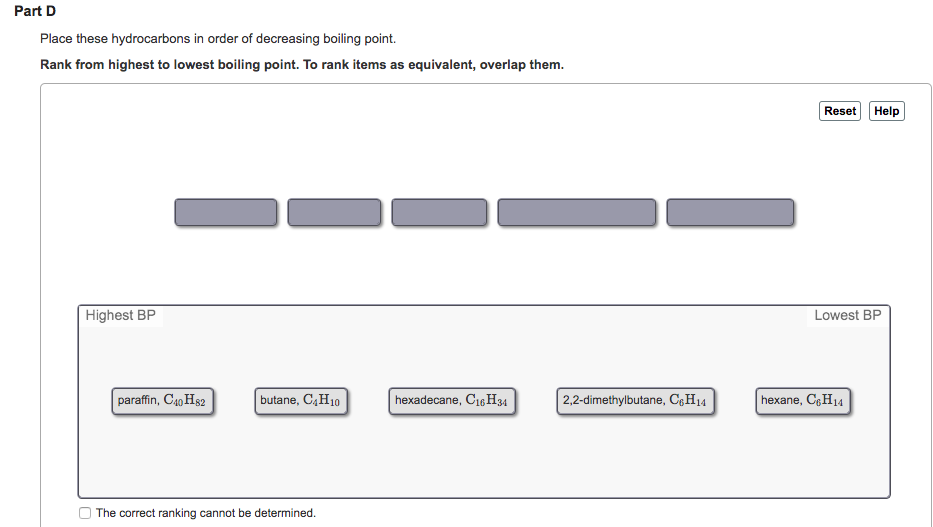
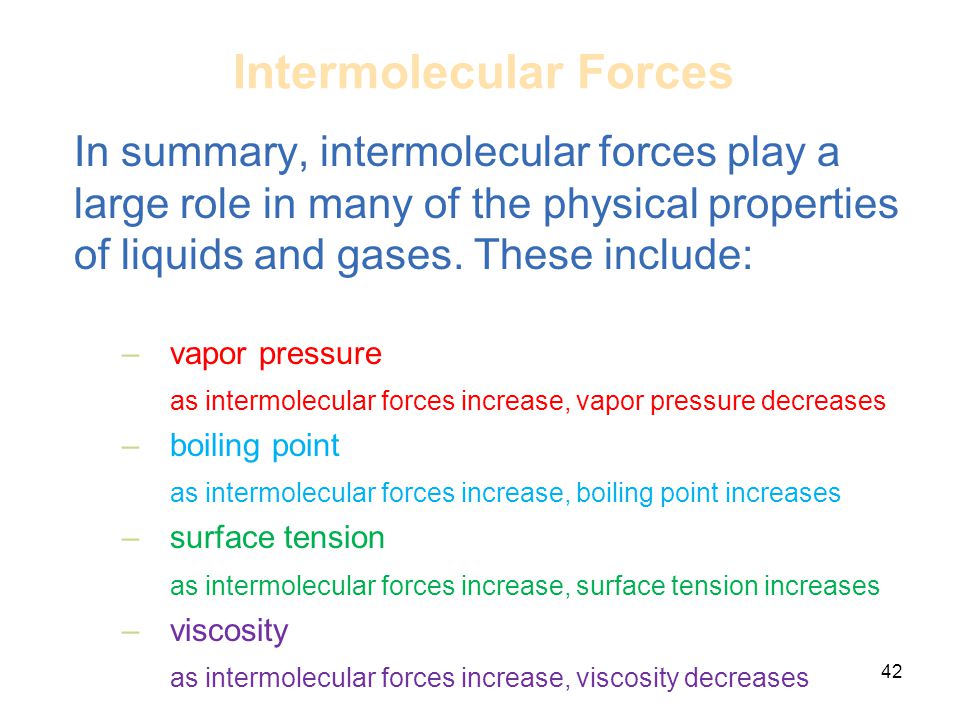
Like covalent and ionic bonds intermolecular interactions are the sum of both attractive and repulsive components. The relative strength of the intermolecular forces IMFs can be used to predict the relative boiling points of pure substances. The forces of attraction or repulsion existing among the particles of atoms or molecules of a solid liquid or gaseous substance other than the electrostatic force that exists among the positively charged ions and forces that hold atoms of a molecule together ie covalent bonds are called intermolecular forces.
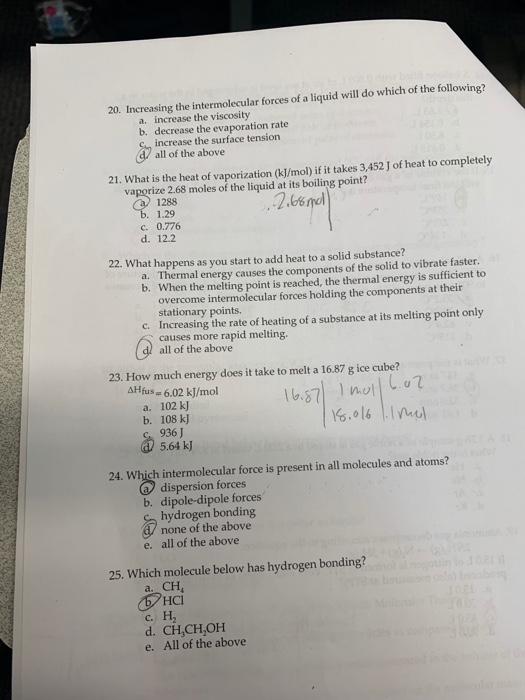
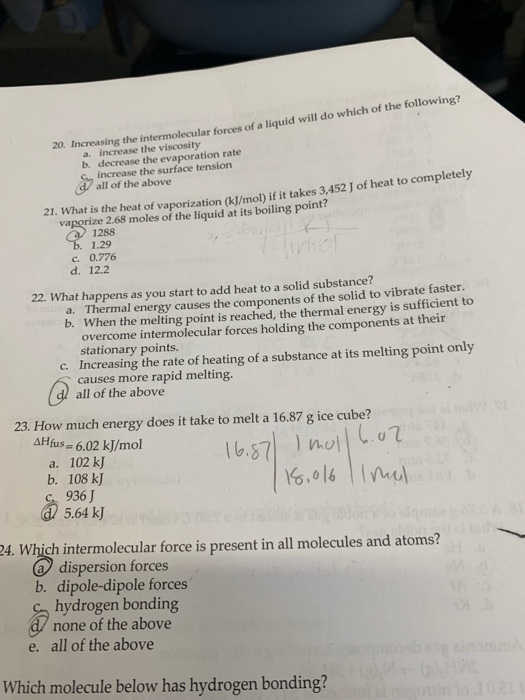
Viscosity increases with stronger intermolecular forces caused by increase in the molecular weight. Intermolecular Forces Viscosity Resistance of a liquid to flow is called viscosity. Attractive and repulsive forces between molecules.
Because electrostatic interactions fall off rapidly with increasing distance between molecules intermolecular. How does NaCl dissolve in water.

Https Www Pinterest Com Explore Le Chatelier S Principle Chemistry Lessons Teaching Chemistry Chemistry Education

States Of Matter Class 11 Notes Chemistry Chapter 5 Learn Cbse States Of Matter Chemistry Chemistry Notes

Chemistry Notes Spontaneity Entropy And Gibbs Free Energy Chemistry Notes Biochemistry Notes Entropy Chemistry
Solved Part A What Happens To These Physical Properties As Chegg Com

Gizmos Student Exploration Carbon Cycle Answered A Solutions Latest Fall 2021 Carbon Cycle Greenhouse Gases Vocab

Pin On A Classroom

Intramolecular Bonding Ppt Download

What Happens To The Intermolecular Force Of Attraction As The Intermolecular Space Between Molecules Decreases

Why Solubility Of Alcohol In Water Decreases With Increasing Molecular Mass Organic Chemistry Books Molecular Mass Solubility

The Effect Of Molecular Surface On The Boiling Point Boiling Point Increases With Surface Organic Chemistry Chemistry Chemistry Study Guide
Solved 20 Increasing The Intermolecular Forces Of A Liquid Chegg Com

Chapter Twelve Physical Properties Of Solutions Outline Of The Chapter The Physical Properties Physics Intermolecular Force

Chemistry Notes Spontaneity Entropy And Gibbs Free Energy Chemistry Notes Biochemistry Notes Entropy Chemistry

Properties Of Covalent Compounds Gcse Eduqas Bonding Structure And Properties Complete Revision Gcse Chemistry Revision Covalent Bonding Gcse Chemistry

Oxidation State It S Determination Oxidation State Ap Chemistry Chemistry Class
1 Topic 11 Liquids And Solids 2 States Of Matter Comparison Of Gases Liquids And Solids Gases Are Compressible Fluids Their Molecules Are Widely Ppt Download
Liquids Solids Ppt Download
Solved 20 Increasing The Intermolecular Forces Of A Liquid Chegg Com

Solubility Of Oxygen In Water Decreases With Rising Temperature Gases Have Weak Intermolecular Forces So There Are Relatively Weak Intermolecular Forces Betwe


Comments
Post a Comment